
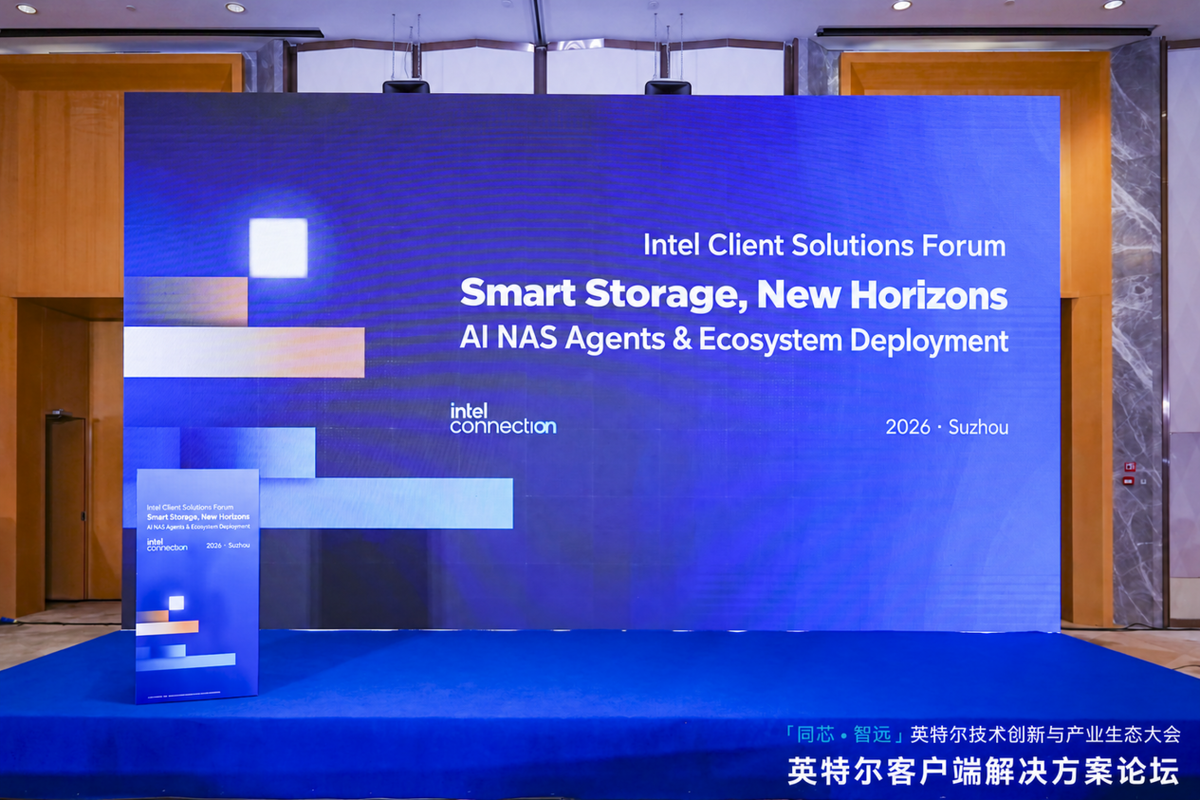
On September 23, Intel hosted its Client Solutions Forum at the Suzhou International Expo Center under the theme “AI NAS Agents and Ecosystem Deployment.”
The forum brought together Intel leaders, technology experts and ecosystem partners to discuss the next generation of AI-enabled storage — including AI NAS product strategy, agent software stacks, native data-agent operating systems and practical deployment models.
(Mr. Gao Yu, General Manager of Intel China Technology Division, delivers the opening remarks.)
As a long-term Intel ecosystem partner and sponsor of Intel Connection 2026, MAXSUN joined the forum to share its perspective on how local compute is changing the role of the NAS.
During the event, Mr. Wang Rong, General Manager of MAXSUN’s Motherboard Business Unit, presented a view of the NAS market evolving through three stages:
Storage → Intelligent NAS → AI Agent NAS.
The key shift is that the competitive focus is moving beyond storage capacity alone.
For the next generation of AI NAS systems, GPU compute and VRAM capacity increasingly determine which AI workloads can actually run locally.
To address this shift, MAXSUN highlighted the Intel® Arc™ Pro B70 32GB as a compute platform for AI Agent NAS applications.
One particularly practical demonstration was the presentation itself: its layouts, visual assets and data visualizations were produced through a local AI workflow powered by the B70. It served as a live example of how professional GPUs can move beyond model inference and become part of an end-to-end local AIGC production pipeline.
The broader goal is to transform NAS from a passive storage device into a system capable of retrieving, understanding, generating and acting on locally stored data.
01 | 32GB of VRAM and Professional AI Compute for Local Models
The MAXSUN Intel® Arc™ Pro B70 32GB features 32GB GDDR6, 608GB/s bandwidth, and up to 367 INT8 TOPS.
For local AI, larger VRAM capacity provides more room for model weights, context, KV cache and runtime memory as workloads grow.
In MAXSUN’s demonstration environment, the B70 supports Qwen3.8-27B-class workloads and long-context applications across enterprise knowledge bases, document processing, agent workflows and multimodal content creation.
With PCIe 5.0 x16 plus AV1 and HEVC encode/decode support, it also fits video generation, transcoding and AI upscaling workflows.
More VRAM means more headroom before memory becomes the constraint.
02 | Containerized Deployment Helps Reduce the Cost of AI Model Iteration
AI models, frameworks and dependencies evolve quickly, making deployment flexibility critical for AI systems.
Through LLM-Scaler Docker, the Arc Pro B70 platform supports containerized deployment, allowing models and inference environments to be packaged into standardized units.
This can simplify validation and integration, reduce software maintenance effort, and help system vendors bring newer local AI capabilities to users faster without repeatedly redesigning the hardware platform.
03 | Three Use Cases That Expand the Role of NAS
Dedicated GPU compute can turn NAS from passive storage into an active local AI platform.
Local AI Agents and Private Knowledge Bases
AI NAS can run local language models and RAG-based retrieval while keeping sensitive documents and project data inside the local environment.
Typical use cases include enterprise search, document processing, contract review and internal knowledge management.
The key benefit is AI assistance with greater control over data privacy and processing.
Agent-Powered AIGC Workflows
For creators, AI NAS can combine storage, generation and post-processing in one local workflow.
Agents can coordinate video generation, AI upscaling, asset search, transcoding and archiving without repeatedly moving content between cloud services and local storage.
This allows NAS to become part of the content production pipeline, not just the repository.
A Local Hub for Smarter Homes
With local language models and agents, AI NAS can also support more natural smart-home interaction.
Instead of simple rule-based automation, users could control lighting, climate, media, security and local services through natural-language requests.
In this model, the NAS becomes a local intelligence layer for the connected home.
04 | Local + Cloud: Rethinking the Economics of Continuous AI Workloads
Local AI does not need to replace the cloud.
For many organizations, a more practical architecture is:
run frequent workloads locally and use cloud resources when additional scale is required.
MAXSUN also demonstrated multi-GPU AI workstation configurations capable of supporting multiple Arc Pro B70 GPUs, creating a higher-density local compute pool.
Frequently used workloads — including model inference, knowledge retrieval, video generation and AI upscaling — can remain on local infrastructure, while cloud resources are reserved for temporary peaks or specialized services.
For organizations running AI tasks continuously, this hybrid model can offer several advantages over a cloud-only approach:
more predictable long-term costs, lower dependence on usage-based API pricing, improved data locality, reduced latency and greater control over computing resources.
The larger idea is therefore not simply:
“Put a GPU inside a NAS.”
It is:
turn storage infrastructure into a local AI platform capable of storing data, understanding it and acting on it.
From motherboards and professional GPUs to multi-GPU AI workstations, MAXSUN continues to expand its local AI hardware portfolio.
Its participation in Intel’s Client Solutions Forum reflects a broader collaboration with Intel around professional graphics, edge AI and intelligent storage platforms.
As storage gains the ability to compute, understand and act, the next generation of NAS may be defined less by how much data it can hold — and more by what it can do with that data.


댓글 남기기
이 사이트는 hCaptcha에 의해 보호되며, hCaptcha의 개인 정보 보호 정책 과 서비스 약관 이 적용됩니다.